
Key facts for GB players before signing up to Bananzia Casino.
| Detail | Key Fact |
|---|---|
| Operator & Licence | Win Top Ltd, licensed in Anjouan |
| Launched | Late 2025 (new brand) |
| Welcome Offer | Crypto deposit bonus, terms vary |
| Game Library | Slots, live casino, sportsbook & jackpots |
| Studio Partners | Multiple studios incl. Pragmatic Play, NetEnt, Evolution |
| Loyalty Perks | 4-tier VIP club, weekly cashback & rakeback |
| Minimum Deposit | Approx. £9 (€10) via crypto |
| Payout Speed | Up to 3 business days |
| Banking Methods | 9 cryptos incl. BTC, ETH, USDT, LTC |
| Mobile Play | Browser-based, no app required |
| Currencies Accepted | EUR, USD, CAD + crypto (no GBP) |



Inside Bananzia Casino
Bananzia Casino
Bananzia is an online casino brand covering reels, dealt tables, live rooms, instant formats and a sportsbook from a single account. Payment routes are usually described by speed, which explains almost nothing, because speed is a symptom. What sets the speed of a route, the minimum attached to it and whether it can receive money back is how the money physically moves and which party pays for moving it. This article starts there and works outwards to the games the money is spent on.
Four rails behind Bananzia payment methods
Every Bananzia funding route reduces to one of four mechanisms, as at any operator, and the differences between them are structural rather than commercial.
| Rail | How money moves | Who pays the cost | What that sets |
|---|---|---|---|
| Card scheme | a message between banks, settled later | the merchant, per transaction | floors and payout speed |
| Open banking | a direct bank-to-bank transfer | the merchant, usually a flat fee | high ceilings, slow out |
| Wallet | a balance moved inside a provider | the merchant and sometimes the user | fast both ways |
| Coin network | a transfer broadcast to a network | the sender, in network fees | minutes, no office hours |
The question of who pays is the one that explains the rest. A rail whose cost falls on the operator sets a minimum high enough to make small transactions worth processing, and a rail whose cost falls on the sender does not need to.

That is why a Bananzia floor on a card is rarely the same figure as a floor on a coin route, and why neither figure is arbitrary. Each sits where the economics of that rail puts it.
The resulting speed follows in turn. A payout's speed is a property of how many institutions have to agree on the movement, and the count runs from one on a coin network to three or four on a card.
Why a card route is the most expensive to run
A card payment into Bananzia is not a transfer of money but an instruction, and the money follows days later through a settlement process involving the issuing bank, the scheme and an acquirer.
Each of those takes a share, and the total is typically a percentage of the transaction plus a fixed amount. That combination is what makes small card payments uneconomic and therefore what sets the floor on a Bananzia payment by card.
The same structure explains the outbound side. A payout to a card is a separate operation on the scheme rather than a reversal, and it waits on the issuing bank's own processing, which is why the band is quoted in business days.
None of that is the operator's timetable. A Bananzia request released on a Friday afternoon is waiting on institutions that do not process at weekends, and no choice the operator makes shortens it.
Open banking and the flat-fee rail
A direct bank transfer into Bananzia carries no scheme in the middle, which changes its cost profile completely.
A flat fee rather than a percentage means large transfers are cheap to process and small ones are not, which is why bank routes usually carry the highest ceilings in a cashier and rarely the lowest floors.
On the way out the same rail is the slowest of the four, because it enters a clearing cycle rather than a provider's own ledger. For a Bananzia account moving large amounts, that trade is often worth making, since the ceiling matters more than the hours.
App-based banking sits in the same family even though it feels like a wallet. It arrives instantly because the payment is initiated and confirmed in one step, and it returns on the bank rail with the bank's own timetable.
Wallets as an intermediary
A wallet is a balance held by a provider, and a Bananzia payment from one is a movement inside that provider rather than between banks.
Which is why wallets are fast in both directions: nothing crosses an institutional boundary until the user moves money out of the wallet itself, and that is a separate step the operator is not part of.
The cost sits with the merchant, usually as a percentage, and sometimes with the user as a withdrawal fee inside the wallet. A Bananzia payout to a wallet can therefore arrive quickly and still carry a cost the casino did not charge.
For phone sessions wallets are also the route with the fewest steps, since the authentication already lives on the device, which is why they dominate mobile deposits across the sector.
Coin routes and the fee the sender pays
A coin transfer into Bananzia is broadcast to a network and confirmed by it, with no institution deciding whether to accept it.
The cost is a network fee paid by whoever sends, which inverts the economics of every other rail. A small transfer is not uneconomic for the operator, which is why coin floors are usually the lowest figures in a cashier.
Settlement is minutes rather than days because confirmation is the only step, and the network does not keep office hours. A Bananzia payout on this rail is effectively immediate once released, which makes release the whole of the timetable.
The trade is that a coin balance holds a coin rather than a currency, so a floating coin's value against sterling moves while it sits there. A stablecoin route avoids that and a volatile one does not.
Why a payout returns the way it came
Route matching is the rule connecting the two halves of the Bananzia cashier, and it exists for anti-money-laundering reasons rather than for convenience.
An operator is responsible for knowing whose money moves and where it goes, and the simplest way to satisfy that is to send money back along the path it arrived on, to an instrument in the verified name.
The practical consequence is that the route decision belongs at the first deposit. By the time a Bananzia payment is being requested outward, the choice has already been made by whatever funded the account.
Where a route cannot receive money back, as happens with some card products, an alternative in the same verified name is requested instead, and that is a document step rather than a preference.
Bananzia bonuses and the clause the rails do not touch
A credited Bananzia amount carries four clauses, and none of them has anything to do with how money arrived.
One sets the multiple of turnover required. One sets the rate at which each shelf counts towards it. One sets the largest stake allowed while the condition runs. And one sets the most that can ever convert into withdrawable money.
Contribution is the clause that connects back to pace. Reels usually count in full and dealt tables at a fraction, so clearing a Bananzia casino bonus on the live floor can take many times the play the same figure takes on the reels.
One rail-specific clause does exist at some operators: a coin deposit occasionally carries its own percentage with no turnover attached. Where that appears, it is the only part of an offer structure that is money on arrival rather than a claim.
What a Bananzia payment looks like end to end
Setting the four rails against one another on a single amount makes the differences concrete, and nothing in the exercise needs a figure the cashier has not published.
Take £200 deposited and £200 later requested back. On every rail the deposit is effectively instant, so the inbound half of the journey is identical in all four cases and carries no decision beyond the floor.
The outbound half separates them completely. A coin route finishes in minutes from release, a wallet within hours, a card in one to three business days and a bank transfer in several, and the ordering is simply the number of institutions that have to act.
Before any of that, the same release step applies on every route. A Bananzia request waits while documents are confirmed and the amount is checked against the account pattern, and only then does the rail timetable above begin.
Bananzia casino games grouped by pace
Money that has arrived in a Bananzia balance is then spent at very different rates depending on where, and pace is the division worth knowing.
Reels resolve in a few seconds, instant formats on a single decision, software tables a little slower, dealt tables on a dealer's cycle of a minute or more, and show formats slowest of all.
House edge is applied to turnover rather than to the stake, so the fastest shelf is the most expensive hour at a given stake and the slowest the cheapest. That single relationship decides how long any deposit lasts.
For anyone matching an amount to an evening, the Bananzia casino games to choose are therefore the slower formats or the low-volatility reels, rather than whichever title is newest.
Bananzia providers and whose figures travel
The reel shelves work the same way with different parties. A studio configures a title's return, its volatility and its features, and certifies the generator behind it.
Those three figures are printed with the game and travel with it wherever it is carried, which is why they are the numbers to read rather than any description. A list of Bananzia providers describes purchasing rather than terms.
What belongs to the operator is everything around the game: the cashier floors above, the conditions on any offer, the ceilings and the account rules. The division is clean and it answers most questions about which figure applies.
Bananzia live casino and the studio behind it
Dealt tables arrive at Bananzia from live studios rather than from the operator, which makes them a separate product with their own rules.
The studio employs the dealer, sets the number of seats, the length of a round, the stake bands and which variants exist. An operator chooses which tables to carry and can narrow a band, and cannot change the cycle of a round.
Stake bands are the practical consequence. A Bananzia live casino table is not one adjustable figure but a set of bands, so choosing where to sit is part of choosing the game, and moving up a band multiplies hourly exposure without changing the mathematics.
Bananzia sportsbook on the same balance
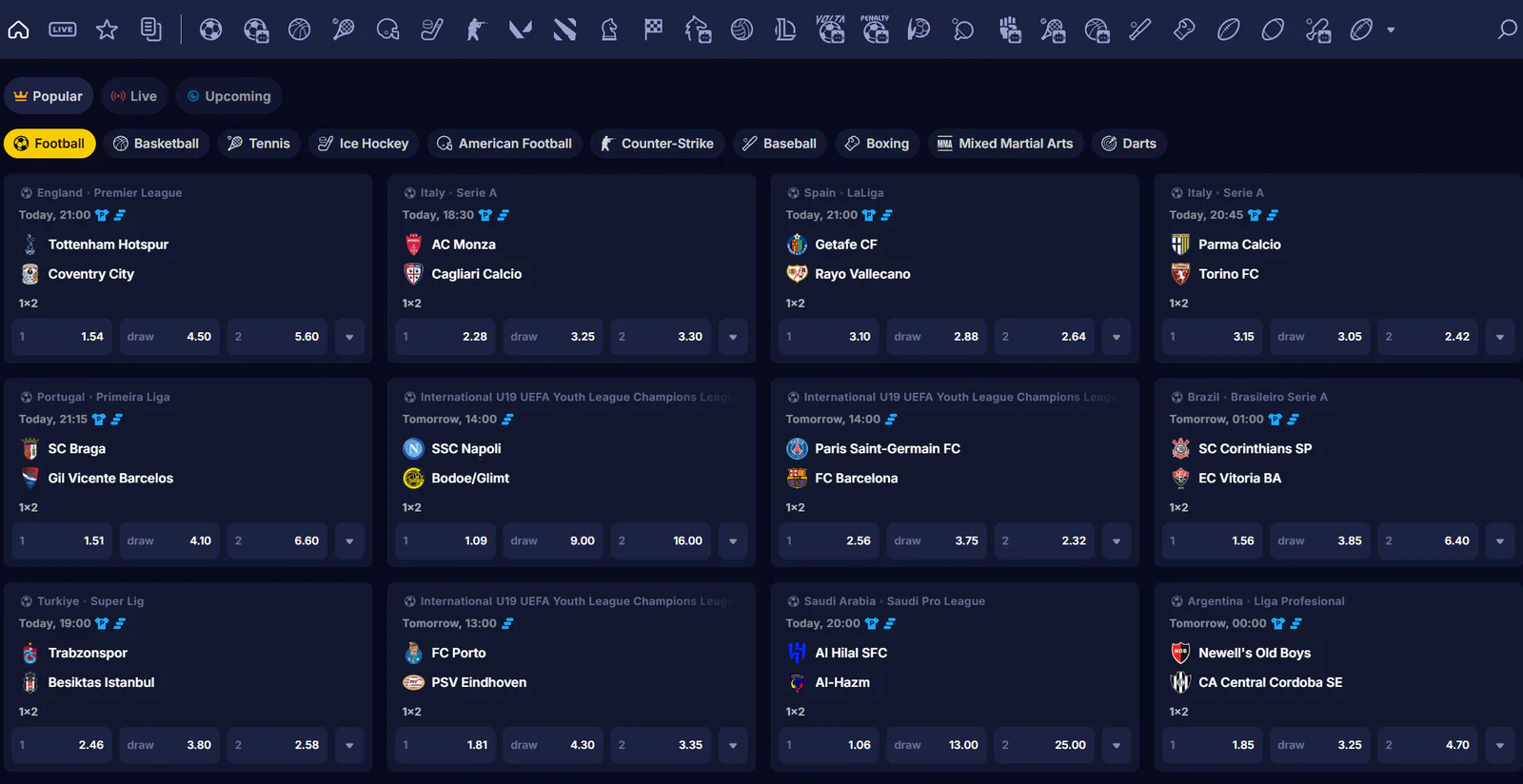
The Bananzia sportsbook shares one balance with the casino, and the difference between them is a clock rather than a rail.
A casino round settles inside the session that placed it. A bet settles on its event, hours or days later, which makes the sportsbook the only part of a Bananzia online casino account that keeps working while nobody is watching.
One rule follows from the shared balance. Where an offer specifies a product, a stake on the other side still leaves the same pot and may contribute nothing towards the condition attached to it.
A Bananzia account and what verification confirms
Three things are checked at Bananzia and they never change: identity, address and ownership of the payment route.
The third is the one the rails above explain. A card has a name on it, a bank account has a name on it, and a coin address has none, which is why coin withdrawals are generally routed back to the address money arrived from.
Submitting documents when a Bananzia account opens costs the same effort as submitting them with a payout waiting, and only the second has a delay attached. The check happens either way.
A Bananzia login and the layers behind it
A Bananzia account holding money, documents and a payment route is protected in three layers rather than by one password.
The password is the first, a one-time code the second, and the verification file already on record the third. A Bananzia login reached without the code cannot be completed, and a session inside cannot redirect money to an unverified name.
The third layer produces the one-account rule, which matters most on the coin rails, since a transfer out of those cannot be recalled once the network has confirmed it.
Figures the Bananzia terms carry
Several figures above belong to the published source rather than to an article: the floor and ceiling on each individual route, the release window before a rail begins, the conditions of any live campaign, and the configured return of each title.
The structure holds whatever those become. Four rails with three different fee payers, a floor set by each rail's economics, a payout returning the way it came, and turnover as the thing every cost is applied to.
Frequently Asked Questions
- 1Why does a Bananzia card withdrawal take longer than a coin withdrawal?A card payout is a separate operation on the card scheme that has to wait on the issuing bank's own processing, which is why it's quoted in business days. A coin payout only needs network confirmation, so it tends to complete within minutes once released. The gap comes down to how many institutions have to act, not any choice Bananzia makes.
- 2Can I withdraw my Bananzia winnings to a different payment method than the one I deposited with?Generally no. Bananzia matches payouts to the route money arrived on, sending funds back to an instrument in the verified account name for anti-money-laundering reasons. If that original route can't receive money back, such as certain card products, you'll be asked for an alternative in the same verified name rather than a method of preference.
- 3Why do coin deposits at Bananzia have lower minimums than card or bank transfers?On a coin network the sender pays the network fee, so a small transfer isn't uneconomic for Bananzia the way a small card payment is. Card and bank routes charge the merchant a percentage or flat fee, which pushes their minimums higher to make processing worthwhile. That's why coin floors are usually the lowest figures in the cashier.
- 4Does a bonus at Bananzia clear faster on slots than on live dealer tables?Yes. Reels usually contribute in full towards the wagering requirement, while dealt tables typically count at only a fraction. This means clearing the same bonus amount on the live casino floor can require many times more play than on slot reels, so the shelf you choose directly affects how quickly the condition is met.
- 5What checks happen before a Bananzia withdrawal is released?Bananzia verifies identity, address and ownership of the payment route being used before a payout is released. These are the same checks already made when the account was opened, so submitting documents early avoids a delay once a withdrawal is pending. Only after this release step is confirmed does the rail's own timetable (minutes to several business days) begin.
- 6Does a bet on the Bananzia sportsbook count towards a casino bonus wagering requirement?Not necessarily. The sportsbook and casino share a single account balance, but where an offer specifies one product, a stake placed on the other side may contribute nothing towards that condition. It's worth checking which product a bonus applies to before splitting stakes between casino games and sports betting.